
Industrialized Construction: A Broader View of What’s Possible
Across the Department of War, there is growing momentum to rethink how infrastructure is delivered.
NAVFAC, USACE, and AFCEC are advancing industrialized construction approaches that shift work offsite, reduce reliance on field labor, and accelerate project timelines. The objective is clear: deliver mission‑ready infrastructure faster and with greater cost predictability.
It’s an important and necessary evolution.
Traditional construction—assembled entirely on site—faces increasing pressure from labor constraints, schedule risk, and rising costs. Moving more work into controlled fabrication environments is a practical step forward.
A Growing Focus on Industrialized Approaches
Much of today’s industrialized construction discussion is focused on modular solutions for facilities such as:
Offices
Barracks
Child development centers
These applications are well suited to modular construction and represent meaningful progress in how buildings are delivered.
At the same time, industrialized construction extends beyond these facility types.
Industrialized Construction in Mission Infrastructure
Large‑span, mission‑critical environments—such as hangars, maintenance facilities, and storage—operate under very different requirements:
Clear span interiors
Exposure to demanding environmental conditions
Integration with operational equipment
Tight timelines tied directly to mission readiness
These environments benefit from many of the same principles driving industrialized construction:
Offsite fabrication
Pre‑engineered systems
Reduced on‑site complexity
Faster transition to operational use
This is where tension fabric structures come into focus.
How Tension Fabric Structures Align with Industrialized Construction
Tension fabric structures apply many of the same ideas central to industrialized construction.
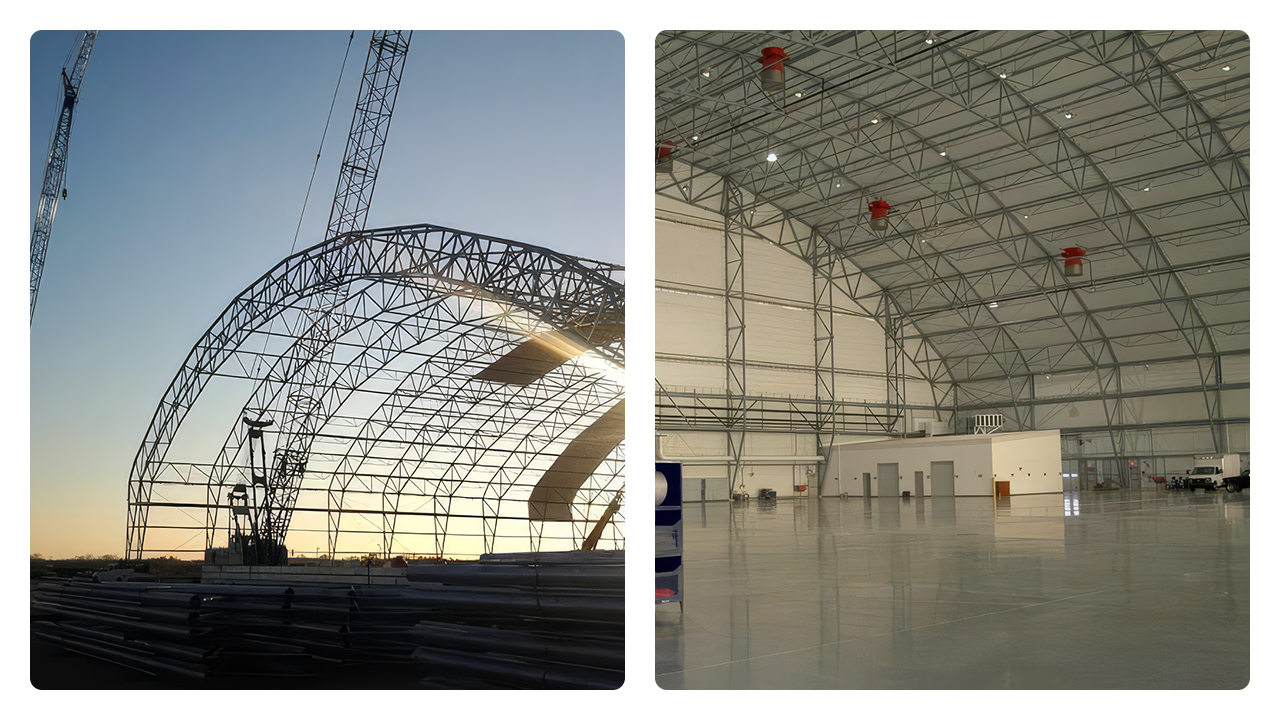
Structural steel components are prepared before arriving on site. Fabric cladding systems are manufactured and readied in advance. By the time installation begins, much of the work that typically occurs in the field has already been completed.
The result is a streamlined installation process where:
Site preparation and structure delivery can occur in parallel
Assembly is efficient and predictable
On‑site labor demands are reduced
This approach reflects the broader goal of improving speed and efficiency in infrastructure delivery.
Speed and Cost Advantages in Practice
When a significant portion of the structure is prepared ahead of time, timelines change meaningfully.
Projects that would traditionally take years to deliver can be completed in months. Structures can move from concept to operational use much faster—an important advantage when mission timelines are compressed.
Cost performance also benefits:
Reduced labor exposure in the field
Fewer schedule disruptions
Lower risk of rework and coordination challenges
For large‑span applications in particular, this creates a compelling alternative to traditional brick‑and‑mortar construction.
Engineered for Real‑World Demands
These structures are not a departure from performance expectations.
Tension fabric structures are engineered to meet:
Building code requirements for wind, snow, and seismic loads
Integration with mechanical, electrical, and fire protection systems
Support for mission‑specific equipment, including cranes and specialized systems
They can also be configured to meet specific operational needs, providing flexibility across a wide range of environments and use cases.
Broadening the Conversation
Industrialized construction is best understood not as a single method, but as a shift in how infrastructure is delivered.
It includes a range of approaches that improve efficiency, reduce schedule risk, and accelerate timelines.
As this conversation continues to evolve across the Department of War, there is an opportunity to take a broader view of what’s possible—considering the full range of solutions that already align with these principles across both building and mission infrastructure.
The Takeaway
The move toward industrialized construction reflects a broader need: delivering infrastructure faster, more efficiently, and in step with mission demands.
That objective applies across all facility types.
Tension fabric structures represent one example of how these principles are already being applied today—particularly in large‑span, mission‑critical environments where speed and cost matter most.